The Retail Play
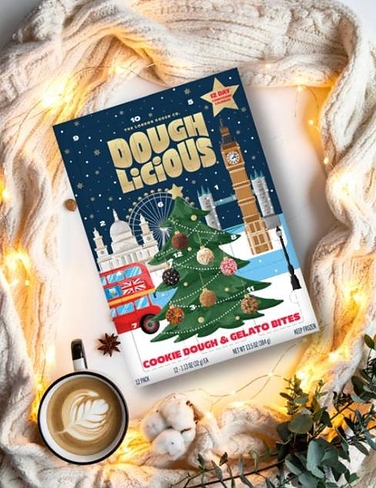
Doughlicious, the Cincinnati-based frozen snack brand founded in London in 2017, is executing a two-retailer holiday strategy that puts its product in two of the most competitive freezer aisles in U.S. specialty and mass retail. A 12-Day Advent Calendar priced at $11.99 launches December 1st exclusively at Target, while Peppermint White Chocolate Cookie Dough & Gelato Bites — a standalone limited-edition SKU at $4.99 promotional SRP — roll out nationwide at Whole Foods Market in early November. For buyers and brand operators watching the frozen better-for-you segment, this kind of dual-channel holiday drop is worth noting: exclusive placement at Target signals a meaningful promotional commitment from the retailer, while Whole Foods distribution validates the brand's positioning in the premium natural channel.
The Collab and the Calendar
The advent calendar itself contains 12 flavors across bite-sized cookie dough and gelato combinations — nine of which are calendar-exclusive — including Gingerbread, Eggnog, Bûche de Noël, and a co-branded collaboration with candy brand Rotten®. Door #7 is the Rotten Cherry Bomb: sour cherry cookie dough wrapped around vanilla gelato and coated in Rotten Sour Crunchies. The inclusion of a candy-brand collaboration inside a frozen advent calendar is a brand-launch tactic worth flagging: it gives both brands incremental retail visibility without requiring a standalone SKU, and it extends Rotten's reach into a frozen occasion it wouldn't otherwise occupy. Rotten Founder and CEO Michael Fisher called the partnership a vehicle for the brand to "sneak our world into places people already love." That framing reflects how smaller candy and snack brands are increasingly using limited-edition foodservice and retail collaborations to buy trial without traditional media spend.
What This Signals for Operators and Buyers
For food and beverage brands angling toward retail distribution, the Doughlicious holiday push illustrates a few durable mechanics. First, the advent calendar format has become a proven retail vehicle in frozen and confectionery — it creates a single SKU that houses multiple flavor introductions and justifies a higher price point without requiring individual item placement across the full assortment. At $11.99 for 12 pieces, the calendar also keeps per-unit cost at $1.00, anchoring the value story for a consumer who might hesitate at a premium frozen novelty. Second, the 100-calories-per-piece messaging and gluten-free oat flour formulation speak directly to the better-for-you positioning that continues to drive incremental freezer door sets at both Target and Whole Foods. Suppliers and co-manufacturers serving the better-for-you frozen segment should watch how Doughlicious's Cincinnati production base positions it for domestic scale as distribution grows. Retail-ready brands in this space, particularly those pursuing brand launch and buyer deck preparation, should study how the dual-channel placement strategy here separates mass and specialty audiences without cannibalizing either. And for operators tracking frozen novelty and LTO mechanics, this is a clean example of how limited-edition SKUs drive seasonal velocity across both grocery and specialty retail.
Written by Michael Politz, Author of Guide to Restaurant Success: The Proven Process for Starting Any Restaurant Business From Scratch to Success (ISBN: 978-1-119-66896-1), Founder of Food & Beverage Magazine, the leading online magazine and resource in the industry. Designer of the Bluetooth logo and recognized in Entrepreneur Magazine's "Top 40 Under 40" for founding American Wholesale Floral, Politz is also the Co-founder of the Proof Awards and the CPG Awards and a partner in numerous consumer brands across the food and beverage sector.