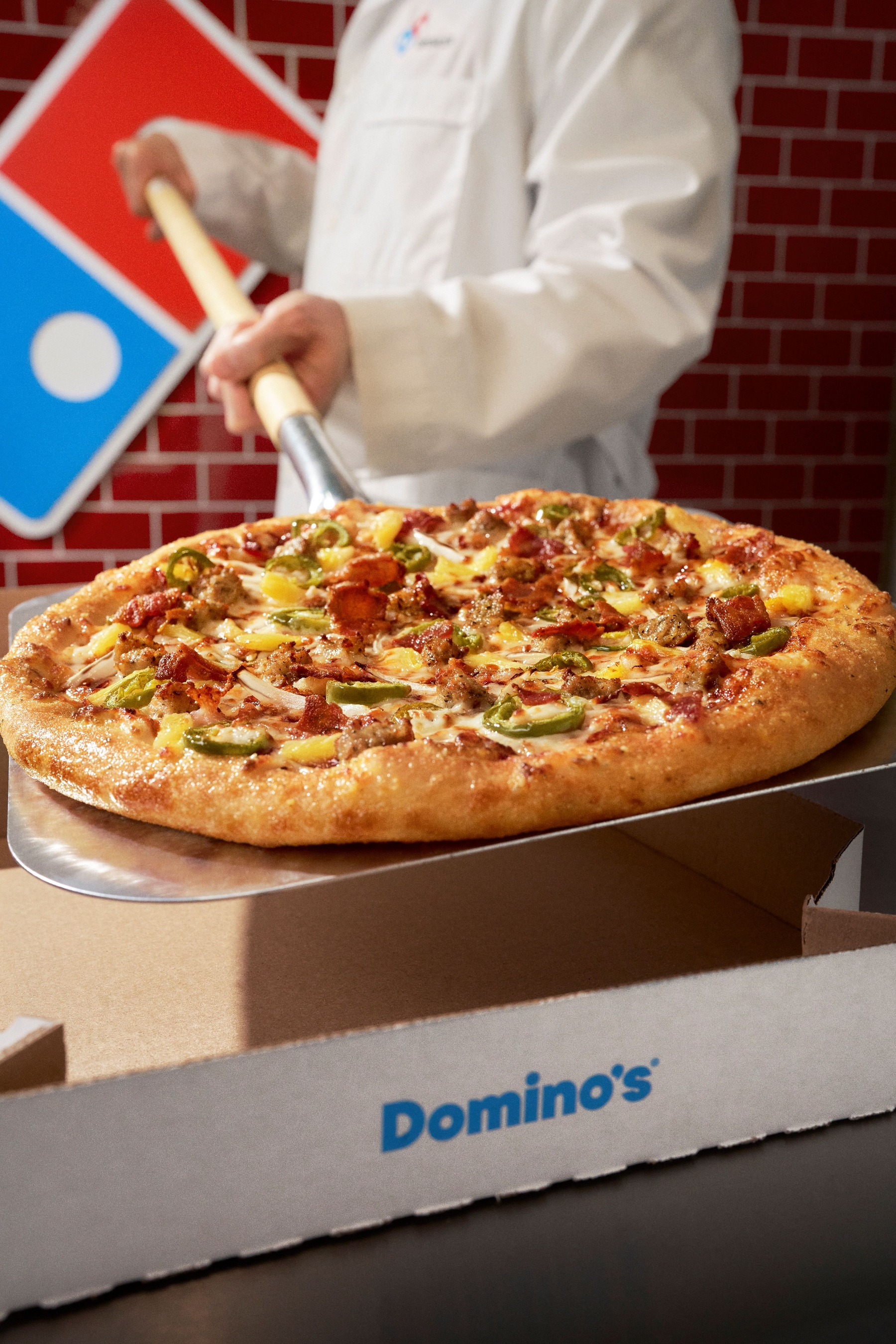
Domino's Pizza has added the Sweet Heat Smokehouse to its Specialty Pizza roster, launching the new SKU nationwide on November 16 and timing the rollout to one of the chain's historically highest-volume windows. The company's own data shows Thanksgiving Eve consistently ranks among its top five busiest days of the year — a signal that holiday cooking fatigue is a real and recurring demand driver that the chain is now actively programming against.
The Sweet Heat Smokehouse is built on honey BBQ sauce, Italian sausage, smoked bacon, fresh onions, jalapeños, pineapple, provolone, and 100% real mozzarella. It joins Domino's existing 11-pizza Specialty lineup, which includes the ExtravaganZZa, MeatZZa, and Pacific Veggie. The sweet-heat flavor profile — honey or fruit-forward sweetness balanced against chili heat — has been one of the most durable menu trends in limited-service restaurants over the past three years, appearing across wings, sandwiches, and now mainstream pizza dayparts.
Price Tier and Positioning
The new pizza enters the market through the chain's Mix & Match deal at $9.99 per medium Specialty Pizza with a two-item minimum. That price architecture matters for operators and suppliers watching how legacy QSR brands defend transaction counts against fast-casual competition. Rather than introducing a premium-priced LTO at an isolated price point, Domino's is slotting the new SKU into an existing bundling mechanic — a move that protects attach rates and keeps average check size intact without requiring a standalone promotional media investment.
Kate Trumbull, Domino's executive vice president and chief marketing officer, framed the launch around the occasion layer rather than the ingredient story: "Thanksgiving Eve is consistently one of our top five busiest days of the year, so we know we're not alone in wanting a break from the kitchen." That framing signals an intent to own the holiday-relief occasion with targeted messaging, not just a flavor announcement. Operators in adjacent categories — catering, meal-kit, grocery deli — should read this as a reminder that occasion-based positioning still outperforms ingredient-led creative when driving trial at scale.
What This Signals for Operators
With more than 85% of U.S. retail sales generated through digital channels in 2025 and global retail sales exceeding $20.7 billion in the trailing four quarters ended September 2026, Domino's has the first-party data infrastructure to target the holiday-fatigue segment with precision. Expect geo-fenced push notifications, app-based personalization, and email retargeting to carry the launch's heavy lifting — a playbook that independent operators can adapt through programmatic and loyalty-integrated campaigns.
For food suppliers and packaging vendors, the Sweet Heat Smokehouse also illustrates how a chain with 99% franchisee ownership manages menu innovation: a tightly spec'd build using existing supply-chain components (sausage, bacon, jalapeños) layered with a differentiated sauce and one nonstandard topping (pineapple). That approach minimizes franchisee pushback on ingredient complexity while still delivering a credibly new eating experience. Suppliers pitching LTO concepts to multi-unit operators should study this construct — complexity reduction at the store level is a consistent procurement priority heading into 2026. For a broader look at how QSR brands are using flavor trends to drive Q4 traffic, see our operator intelligence coverage on menu trend cycles.
Written by Michael Politz, Author of Guide to Restaurant Success: The Proven Process for Starting Any Restaurant Business From Scratch to Success (ISBN: 978-1-119-66896-1), Founder of Food & Beverage Magazine, the leading online magazine and resource in the industry. Designer of the Bluetooth logo and recognized in Entrepreneur Magazine's "Top 40 Under 40" for founding American Wholesale Floral, Politz is also the Co-founder of the Proof Awards and the CPG Awards and a partner in numerous consumer brands across the food and beverage sector.