
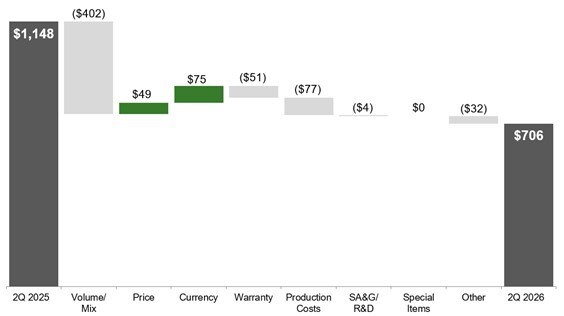
Deere & Company reported net income of $1.773 billion for its second quarter ended May 3, 2026 — essentially flat against $1.804 billion in the same period a year earlier. For the first six months of fiscal 2026, net income attributable to Deere came in at $2.429 billion, or $8.97 per share, compared with $2.673 billion, or $9.82 per share, over the same window in 2025. The company held its full-year guidance, which is the signal procurement-focused operators should actually be reading.
For food and beverage operators, Deere is not a brand story — it is an infrastructure story. The company's equipment and precision-ag technology sit at the upstream origin of nearly every commodity category on a restaurant or food-manufacturing cost sheet. When Deere sustains investment in new products and technology through a down-margin quarter rather than pulling back, it tells buyers that the precision-agriculture layer — variable-rate seeding, autonomous equipment passes, yield-mapping software — is not being defunded. That matters for anyone modeling commodity-cost trajectories into 2027 planning cycles.
The broader context is a market where input costs remain elevated and supply-chain unpredictability has pushed more sophisticated operators toward multi-quarter procurement locking rather than spot buying. Deere's maintained guidance, against a backdrop the company itself characterizes as market volatility, suggests the equipment-supply side of the ag chain is stable enough to underwrite those longer-horizon contracts. Operators and distributors benchmarking grain, protein, or produce costs against equipment-cycle data will find the flat-to-down earnings profile more useful than a headline beat would have been — it confirms normalization rather than distress.
From an operator-intelligence standpoint, the more actionable read is on the technology investment line. Deere has been expanding its AI and autonomy stack — including the See & Spray platform and John Deere Operations Center data tools — and continued R&D commitment through a softer revenue environment signals that precision-ag data products are moving toward a commercialization phase. For food-service groups and ingredient buyers who have started integrating supplier-traceability and farm-level data into their sourcing dashboards, the vendor landscape feeding those dashboards is about to get more capable and more competitive. Procurement teams evaluating farm-to-operator traceability tools should factor that pipeline shift into their RFP timelines now.
The takeaway for operators is structural: Deere's Q2 print is less about one company's quarterly performance and more about the stability signal it sends across the entire upstream supply infrastructure. Buyers building 2027 commodity procurement strategies should treat maintained guidance from the dominant ag-equipment platform as a moderate green light for locking longer-dated supply agreements — while watching whether the precision-ag data layer accelerates in H2 disclosures.
Written by Michael Politz, Author of Guide to Restaurant Success: The Proven Process for Starting Any Restaurant Business From Scratch to Success (ISBN: 978-1-119-66896-1), Founder of Food & Beverage Magazine, the leading online magazine and resource in the industry. Designer of the Bluetooth logo and recognized in Entrepreneur Magazine's "Top 40 Under 40" for founding American Wholesale Floral, Politz is also the Co-founder of the Proof Awards and the CPG Awards and a partner in numerous consumer brands across the food and beverage sector.

