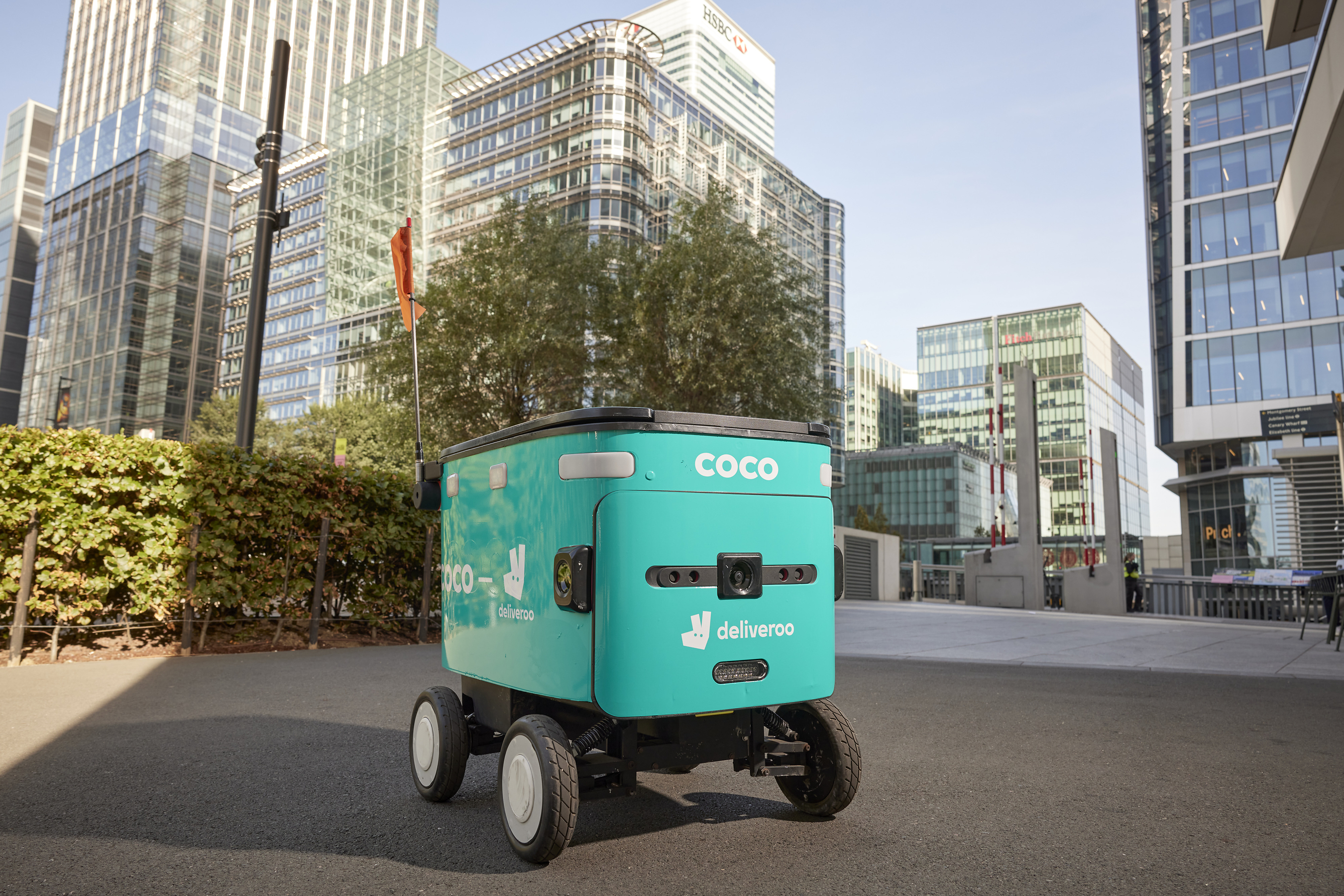
Sidewalk delivery robots are arriving in UK restaurants' back-of-house calculus. Coco Robotics and Deliveroo announced an exclusive partnership that puts Coco's fully electric, AI-navigated robots into UK urban delivery networks beginning October 2026 in London's Canary Wharf, with Milton Keynes, Leeds, Stockton on Tees, and Nottingham to follow in the coming months. For foodservice operators on Deliveroo's platform, this is the first time autonomous ground vehicles will appear as a fulfillment option in the UK.
Coco has logged more than 500,000 zero-emission deliveries across 4,500-plus restaurant and retail partners in the U.S. and Europe since its 2020 founding. That operational history — built alongside DoorDash and Wolt in Los Angeles, Chicago, Miami, Washington D.C., and Helsinki — gives the company real-world training data that most new-market entrants lack. The UK launch extends a DoorDash ecosystem play: Deliveroo joined DoorDash's global portfolio in 2025, and the Coco relationship now mirrors what DoorDash already runs in the U.S., where the company is also testing its own in-house robot, Dot, in the Phoenix metro.
What Operators Should Watch
For restaurant and retail merchants on Deliveroo, the immediate practical change is a second fulfillment tier alongside the existing rider network. Coco's robots are positioned for short-distance, urban-density orders — the last few hundred meters where speed, congestion, and emissions are friction points. Deliveroo CEO Miki Kuusi described the intent as building a "multi-modal last-mile delivery approach," meaning operators could see order routing shift between human couriers and robots based on distance, time of day, or street conditions — without any action required on the merchant side.
Launch merchant partners at Canary Wharf include Patty&Bun, bakery Signorelli, and cafe-restaurant Beam, with Ole & Steen, Royal China, and Din Tai Fung named as near-term additions. That mix of fast-casual, bakery, and full-service dining signals Coco is not limiting the channel to quick-service only — relevant intelligence for operators across dayparts and cuisine categories considering Deliveroo's platform.
Infrastructure and Accessibility
Coco's robots use onboard sensors, cameras, and edge-computing AI navigation — processing environmental data locally rather than relying on cloud connectivity, which reduces latency risk in dense pedestrian corridors. Deployment follows a phased, regulation-aligned model, with location-specific speed limits and routing policies enforced at the software level. The company is also sharing real-time sidewalk hazard data with BlindSquare, whose self-voicing app alerts blind and partially sighted pedestrians to obstacles. BlindSquare founder Ilkka Pirttimaa noted the data feed identifies conditions like discarded e-scooters and temporary construction zones, flagging Coco's fleet as infrastructure intelligence as much as a delivery mechanism.
Local authority support has been secured across rollout cities. Coco is in active discussions with additional councils in London and elsewhere in the UK, and the company is investing in local depot and charging facilities — a signal that this is a multi-year infrastructure commitment, not a pilot. For suppliers and vendors in the hospitality tech space, the local operational buildout represents procurement opportunity in maintenance, logistics staffing, and charging infrastructure across each city. Operators evaluating last-mile delivery technology for their own stack should track how Coco's phased city expansion maps to their own footprint decisions.
The broader competitive picture: DoorDash, Wolt, and Deliveroo are all running parallel autonomous vehicle experiments across geographies, including aerial drone programs. The Coco partnership is one piece of a platform-level bet that multi-modal delivery — not a single method — is where last-mile fulfillment is heading. Operators whose revenue is meaningfully tied to delivery platforms should be monitoring how delivery platform AI investments affect restaurant economics as these networks mature.
Written by Michael Politz, Author of Guide to Restaurant Success: The Proven Process for Starting Any Restaurant Business From Scratch to Success (ISBN: 978-1-119-66896-1), Founder of Food & Beverage Magazine, the leading online magazine and resource in the industry. Designer of the Bluetooth logo and recognized in Entrepreneur Magazine's "Top 40 Under 40" for founding American Wholesale Floral, Politz is also the Co-founder of the Proof Awards and the CPG Awards and a partner in numerous consumer brands across the food and beverage sector.