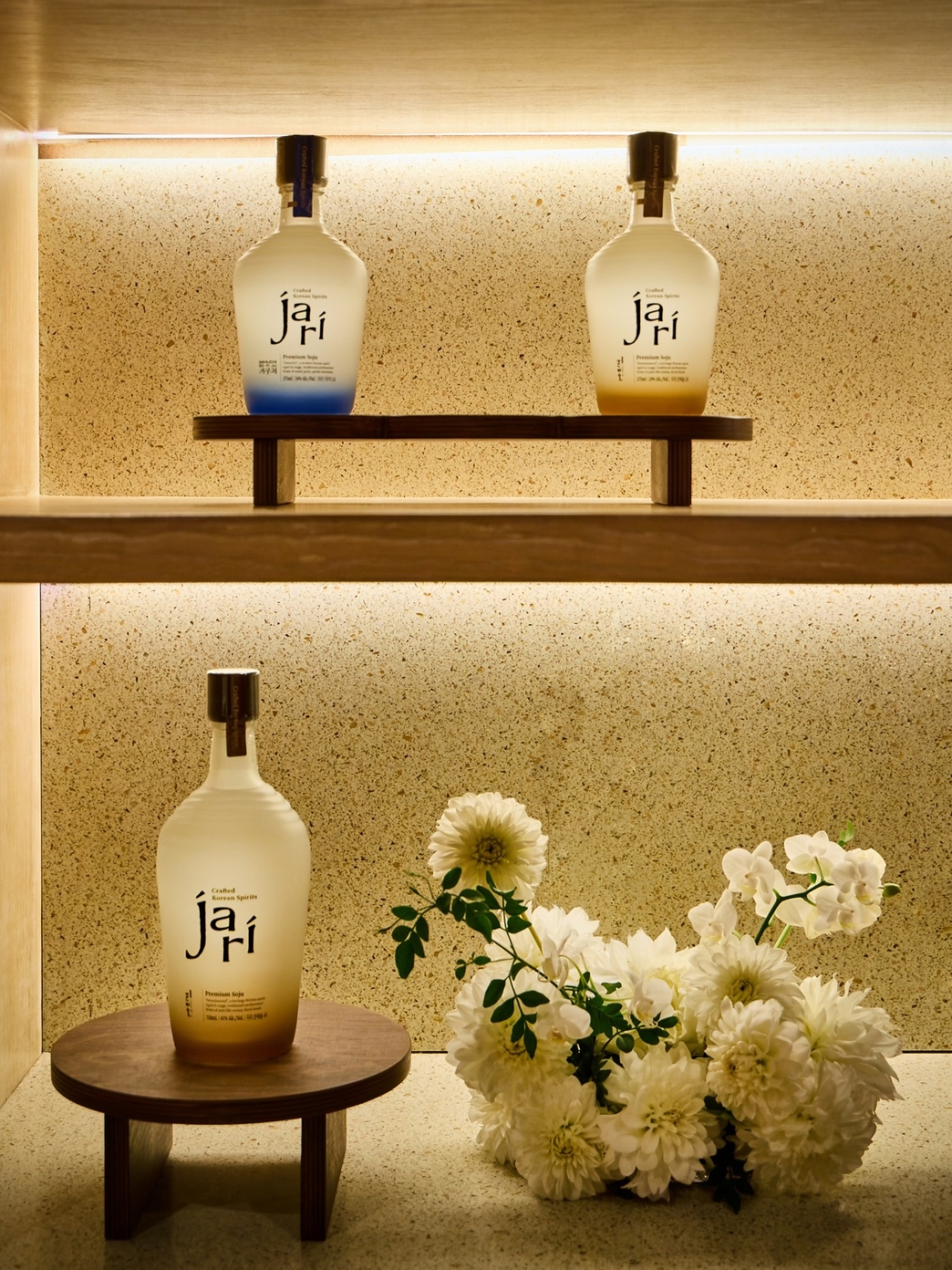
CJ CheilJedang's jari is now available at select premium Korean restaurants and retail outlets in New York, bringing the company's first dedicated Korean spirits brand to the U.S. market after an earlier domestic rollout in Korea. The debut targets Michelin-starred fine dining establishments — a deliberate on-premise entry strategy that positions jari alongside the elevated beverage programs operators at that tier already maintain.
Three SKUs, One Positioning Play
The launch lineup consists of three expressions: jari Moonbaesool 24 (24% ABV), jari Moonbaesool 41 (41% ABV), and jari Gamuchi 24 (24% ABV). All three are aged across four seasons in traditional, unglazed Onggi ceramic jars — a process that distinguishes them from the filtered soju and commodity makgeolli that currently dominate Korean beverage sections in U.S. foodservice. Moonbaesool carries designation as a National Intangible Cultural Heritage of Korea, a credentialing hook that gives sommeliers and beverage directors a storytelling framework comparable to what appellations and AOC designations do for European spirits. Gamuchi, made from freshly harvested Chungju rice, rounds out the range with a softer, more approachable profile suited to cocktail builds.
All three expressions received top honors at the 2026 IWSC and ISC ahead of the U.S. debut — third-party validation that matters when a brand is asking buyers and program directors to open a new spirits category on a menu.
What This Signals for Operators
The K-Food wave has already reshaped center-of-plate at casual and upscale dining alike, with bibigo™ dumplings and Korean pantry ingredients moving through retail and foodservice channels at scale. Beverage programs have lagged, largely because no well-capitalized brand had committed to U.S. on-premise distribution with the kind of chef partnerships and pairing infrastructure that jari is now deploying. CJ CheilJedang's launch event — a five-course pairing dinner hosted by chef Irene Yoo, author of Soju Party, with cocktails from Pine & Co. mixologist Du-ui Hong — functions less as PR and more as a proof-of-concept for operators evaluating whether K-Spirits can sustain a dedicated section on a beverage list.
For restaurant operators building or refreshing beverage programs, the entry of a well-funded platform brand into Korean spirits creates both an opportunity and a benchmark. Independent Korean restaurants that already pour commodity soju now have a premium tier to upsell against. Non-Korean restaurants — Japanese, pan-Asian, and American fine dining — have a spirits category to explore that carries cultural depth and media momentum. The brand launch playbook here mirrors what Japanese whisky did a decade ago: anchor at the top of the market, earn press through chef alignment, then widen distribution as consumer familiarity grows.
Gregory Yep, CEO of CJ Foods at CJ CheilJedang, framed the U.S. move as an effort to open new possibilities for "how Korean spirits are discovered, served, and enjoyed" — language that signals the company intends to invest in trade education, not simply drop product and wait for pull-through. Beverage directors considering the SKUs should expect to engage with a brand that will support menu integration with training materials and pairing guidance, consistent with how premium sake importers have operated in the U.S. fine dining tier.
Written by Michael Politz, Author of Guide to Restaurant Success: The Proven Process for Starting Any Restaurant Business From Scratch to Success (ISBN: 978-1-119-66896-1), Founder of Food & Beverage Magazine, the leading online magazine and resource in the industry. Designer of the Bluetooth logo and recognized in Entrepreneur Magazine's "Top 40 Under 40" for founding American Wholesale Floral, Politz is also the Co-founder of the Proof Awards and the CPG Awards and a partner in numerous consumer brands across the food and beverage sector.