
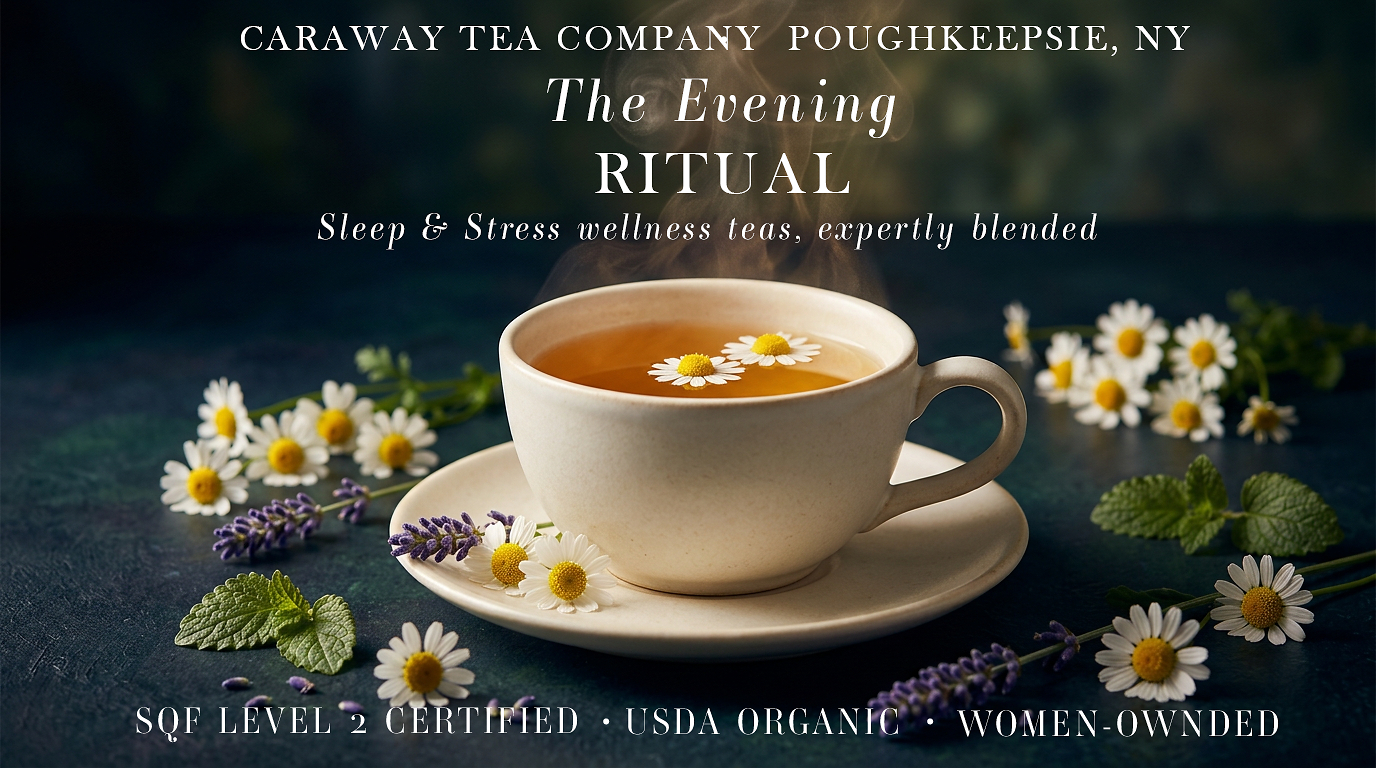
Caraway Tea Company, a SQF Level 2-certified, USDA Organic, women-owned co-packer operating out of New York's Hudson Valley, has announced expanded manufacturing capacity specifically for sleep and stress-support herbal blends. The move is a direct response to accelerating wholesale inquiry in a segment that is quietly becoming one of the more competitive build-outs in beverage procurement right now. For operators sourcing private-label or co-packed tea programs — hotels, wellness resorts, specialty grocers, and DTC brands — this signals that qualified, certified capacity is starting to catch up with demand.
The underlying category data is hard to ignore. Chamomile holds roughly 32% of the global herbal ingredient market, making it the single most consumed wellness botanical worldwide. Sleep-supporting herbal teas rank among the highest-growth wellness beverage segments entering the second half of 2026, with brands across retail and direct-to-consumer channels constructing full product lines around what the industry is now calling the "wind-down occasion." For hospitality operators building in-room amenity programs or spa retail sets, this is not a peripheral trend — it is becoming a baseline expectation from guests with disposable income and a preference for functional products.
From a procurement standpoint, Caraway's expansion matters because certified co-pack capacity at this specification level — USDA Organic combined with SQF Level 2 food safety — is not uniformly available at small-to-mid run volumes. Brands and operators who waited on sleep-blend development while watching retail velocity are now entering sourcing conversations at a moment when lead times and minimum order quantities are the variables most likely to determine speed to shelf. Operators reviewing private-label beverage programs should factor co-packer certification tier into their RFP criteria alongside price-per-unit, not after it.
The women-owned designation also carries practical value beyond optics. Several regional grocery chains and hospitality group procurement policies now include supplier diversity scoring in vendor selection. For operators whose buyers are fielding pressure to diversify the supply chain, a certified women-owned co-packer with expanded capacity in a high-velocity category is a defensible line item. Teams building or refreshing wellness beverage programs for hotel F&B should be tracking co-packer qualification as a strategic asset, not just a production detail.
The broader signal here is that sleep and stress wellness is graduating from trend to infrastructure inside both retail and foodservice. Operators who treat it as a permanent occasion — evening service, turndown amenity, spa retail, DTC subscription — and source accordingly will be better positioned than those chasing the category reactively when shelf resets come due.
Written by Michael Politz, Author of Guide to Restaurant Success: The Proven Process for Starting Any Restaurant Business From Scratch to Success (ISBN: 978-1-119-66896-1), Founder of Food & Beverage Magazine, the leading online magazine and resource in the industry. Designer of the Bluetooth logo and recognized in Entrepreneur Magazine's "Top 40 Under 40" for founding American Wholesale Floral, Politz is also the Co-founder of the Proof Awards and the CPG Awards and a partner in numerous consumer brands across the food and beverage sector.

