Frozen Gimbap from bibigo is now stocked in the freezer aisles of Kroger, Albertsons, Meijer, Food Lion, Giant Eagle, Hy-Vee, and several regional banner chains — and the velocity numbers behind that footprint are worth watching. Dollar sales are up 59.0% and store distribution has grown 146.0% year-to-date on an eight-period basis, according to CJ Schwan's. For retail buyers, category managers, and foodservice operators tracking what consumers are putting in their carts, that growth rate signals a category shift, not a trend blip.
The Campaign Architecture
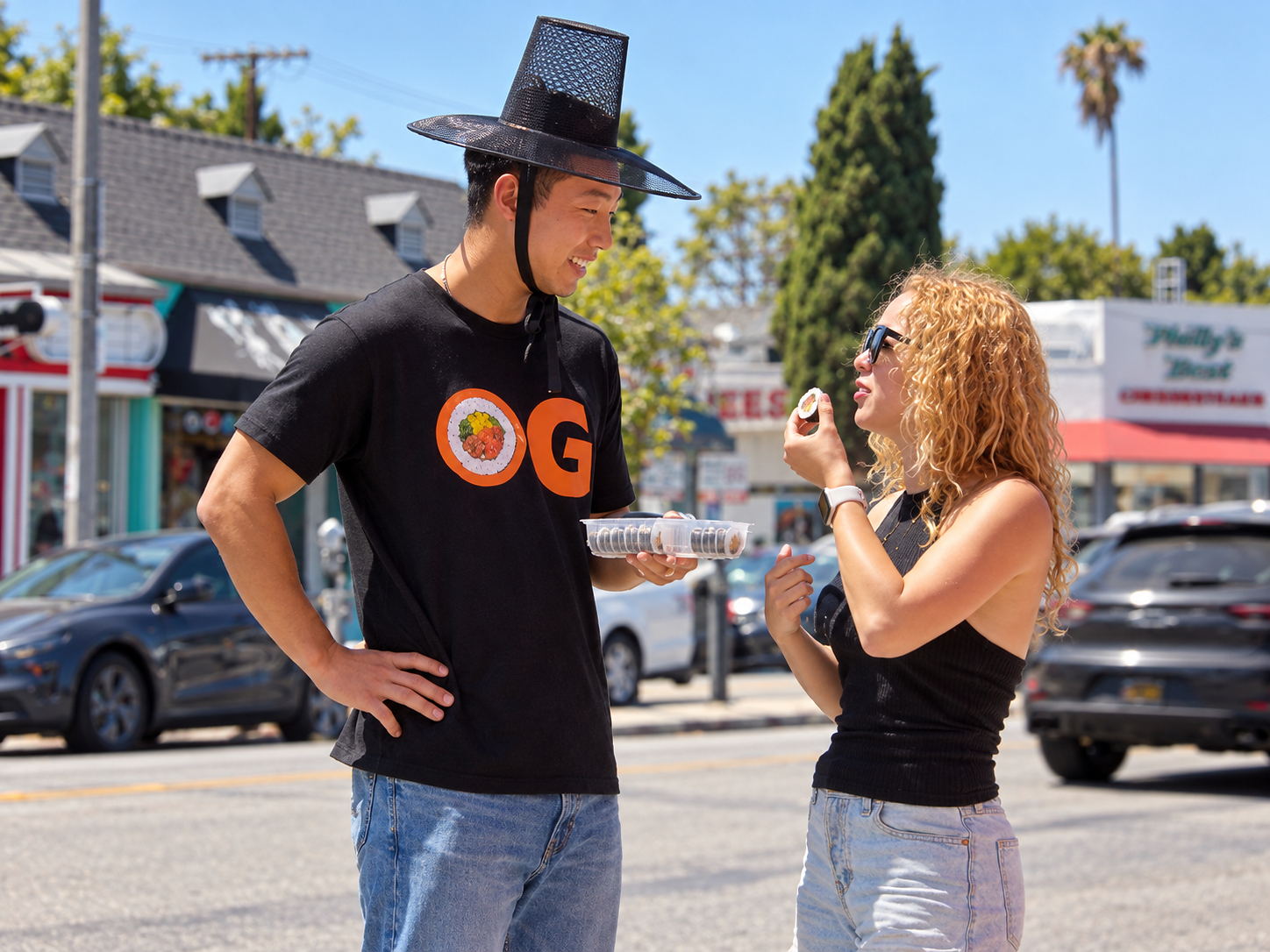
The brand's "OG Recognizes OG" push combines two levers operators and brand managers should study closely: hyper-local physical activation and scalable social mechanics. In late August, bibigo partnered with Gen-Z food creator Danny Kim — whose combined following across TikTok and YouTube approaches 9 million — to host street-level samplings on Melrose and a dedicated "OG Zone" event at Echo Park. The L.A. activations featured Korean-American creators including rapper Dumbfounded (Jonnie Park), lifestyle influencer Emily Boe, and UCLA's K-pop dance crew Koreos. The on-the-ground footprint fed content directly into the @bibigoUSA TikTok challenge, compressing the sampling-to-social loop that traditionally required separate budget lines.
That integrated approach — local activation as content production — is increasingly common among challenger CPG brands scaling into mainstream grocery. For operators building a brand launch plan or advising food clients on retail readiness, bibigo's playbook here is a functional template: anchor in a culturally credible market (Los Angeles), partner with creators who have authentic category authority, and let the event footage do double duty as paid and organic social fuel. The Brand Launch Department has covered similar two-phase rollouts from other Asian-cuisine entrants over the past 18 months.
What Buyers Are Watching
The broader context matters as much as the campaign mechanics. Korean food culture — K-drama, K-pop, and increasingly K-food — has been compressing what used to be a multi-year adoption curve for international CPG categories into 12-to-18-month retail cycles. Gimbap specifically has moved from niche specialty import to national frozen-aisle SKU faster than most analogous ethnic-food crossovers. Federico Arreola, president of the Asian Cuisine division at CJ Schwan's, frames the product's positioning around portability and protein content — 12 grams of vegetable protein per serving — which maps directly onto the functional-snacking language retail buyers are currently rewarding with shelf space.
For distributors and procurement teams, the 146.0% distribution expansion is a ceiling-check signal: the brand is still in a rapid door-count phase, which means incremental placement conversations are likely active across regional chains not yet listed. Operators sourcing grab-and-go or heat-and-serve options for non-commercial or convenience foodservice channels should note that the microwaveable format already solves for back-of-house simplicity. Coverage of adjacent procurement shifts in the frozen and ethnic-food aisle is available in our Operator Intelligence reporting.
The Food & Beverage Magazine network has tracked K-food's grocery penetration for several cycles; this launch represents one of the more structured national rollouts in the category to date, combining distribution scale with a creator-economy amplification model that smaller regional brands will likely benchmark against.
Written by Michael Politz, Author of Guide to Restaurant Success: The Proven Process for Starting Any Restaurant Business From Scratch to Success (ISBN: 978-1-119-66896-1), Founder of Food & Beverage Magazine, the leading online magazine and resource in the industry. Designer of the Bluetooth logo and recognized in Entrepreneur Magazine's "Top 40 Under 40" for founding American Wholesale Floral, Politz is also the Co-founder of the Proof Awards and the CPG Awards and a partner in numerous consumer brands across the food and beverage sector.