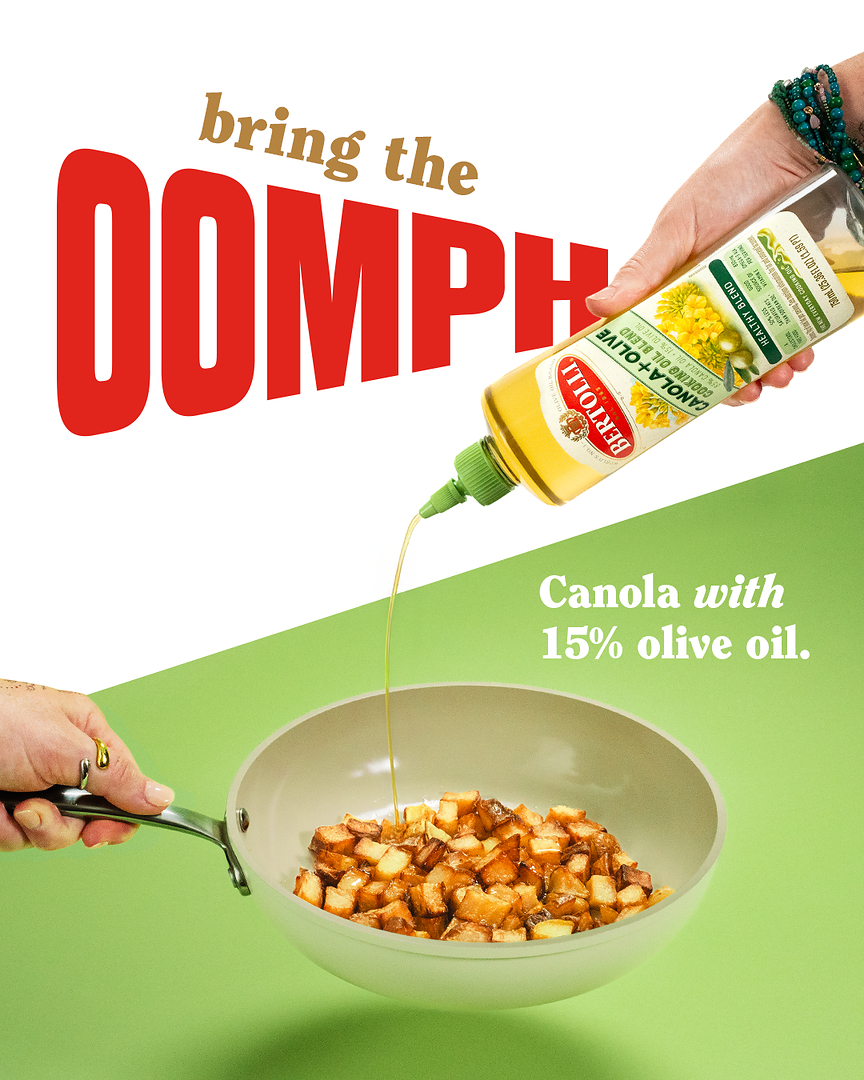
An 85/15 canola-olive oil blend from Bertolli is now on Kroger shelves nationwide, the first retail move from parent company Deoleo explicitly designed to pull non-olive-oil households into the category rather than trade existing users up.
The product, Bertolli Canola + Olive Oil, launches in a 25.36 fl. oz. squeeze bottle and a 50.72 fl. oz. family-size format. Retail pricing starts at $6.99 and varies by market. Amazon is a simultaneous channel, with broader retail distribution described as rolling out soon.
The Category Gap
Deoleo's own Circana panel data, covering 52 weeks ending July 12, 2026, puts the share of U.S. households that do not use olive oil at 43%. That number is the strategic rationale for the blend format: neutral taste, high-heat performance, and a familiar canola profile are intended to reduce the friction that holds back trial. The formulation delivers omega-3 ALA and vitamin E, attributes that align with the 2025–2030 Dietary Guidelines for Americans and give retail buyers a health-positioning story at a competitive price point.
Maca Garau, Vice President of Marketing North America and LATAM at Deoleo, described the accompanying campaign — titled "Bring the Oomph" — as an on-ramp rather than a conquest play against pure olive oil. The positioning is additive: bring canola users into the olive oil category, not away from it.
What Retail Buyers Should Watch
For grocery category managers, a blend SKU at the $6.99 entry opens shelf space at a tier below premium single-origin olive oils without cannibalizing them. The squeeze-bottle format is a deliberate convenience signal aimed at everyday cooking occasions — sautéing, roasting, baking — where canola has historically dominated by default.
For foodservice distributors and operators sourcing cooking oils at scale, the launch signals that the major olive oil brands are competing directly on versatility and price accessibility, not just provenance and flavor. That matters for menu-costing conversations: if a blended oil can carry an olive oil health halo at canola-adjacent price points, it changes the calculus for back-of-house oil purchasing on lower-margin dayparts.
Thierry Moyroud, CEO of Deoleo North America and LATAM, framed the launch explicitly as category growth strategy: "We believe growing the olive oil category starts by making that first step easier." That language is worth noting in buyer and broker meetings — Deoleo is positioning this as a category-builder, which typically comes with stronger trade support and marketing investment than a pure share-steal would.
Signals for Operators and Brands
The Bertolli blend launch is a textbook example of a brand-launch play that uses a lower-barrier SKU to expand the total addressable market rather than defend an existing premium position. Brands in adjacent categories — specialty vinegars, infused oils, Mediterranean pantry staples — should watch the distribution rollout as a signal of where Deoleo is prioritizing retail relationships heading into 2027.
For operators building out retail-ready product lines, the pricing architecture here is instructive: $6.99 entry, dual-channel (mass grocery plus Amazon), and a health-forward claim anchored to federal dietary guidelines. That combination is increasingly the table stakes for any cooking ingredient brand trying to win incremental households rather than just deepen penetration among existing loyalists.
Written by Michael Politz, Author of Guide to Restaurant Success: The Proven Process for Starting Any Restaurant Business From Scratch to Success (ISBN: 978-1-119-66896-1), Founder of Food & Beverage Magazine, the leading online magazine and resource in the industry. Designer of the Bluetooth logo and recognized in Entrepreneur Magazine's "Top 40 Under 40" for founding American Wholesale Floral, Politz is also the Co-founder of the Proof Awards and the CPG Awards and a partner in numerous consumer brands across the food and beverage sector.