The Seasonal Play
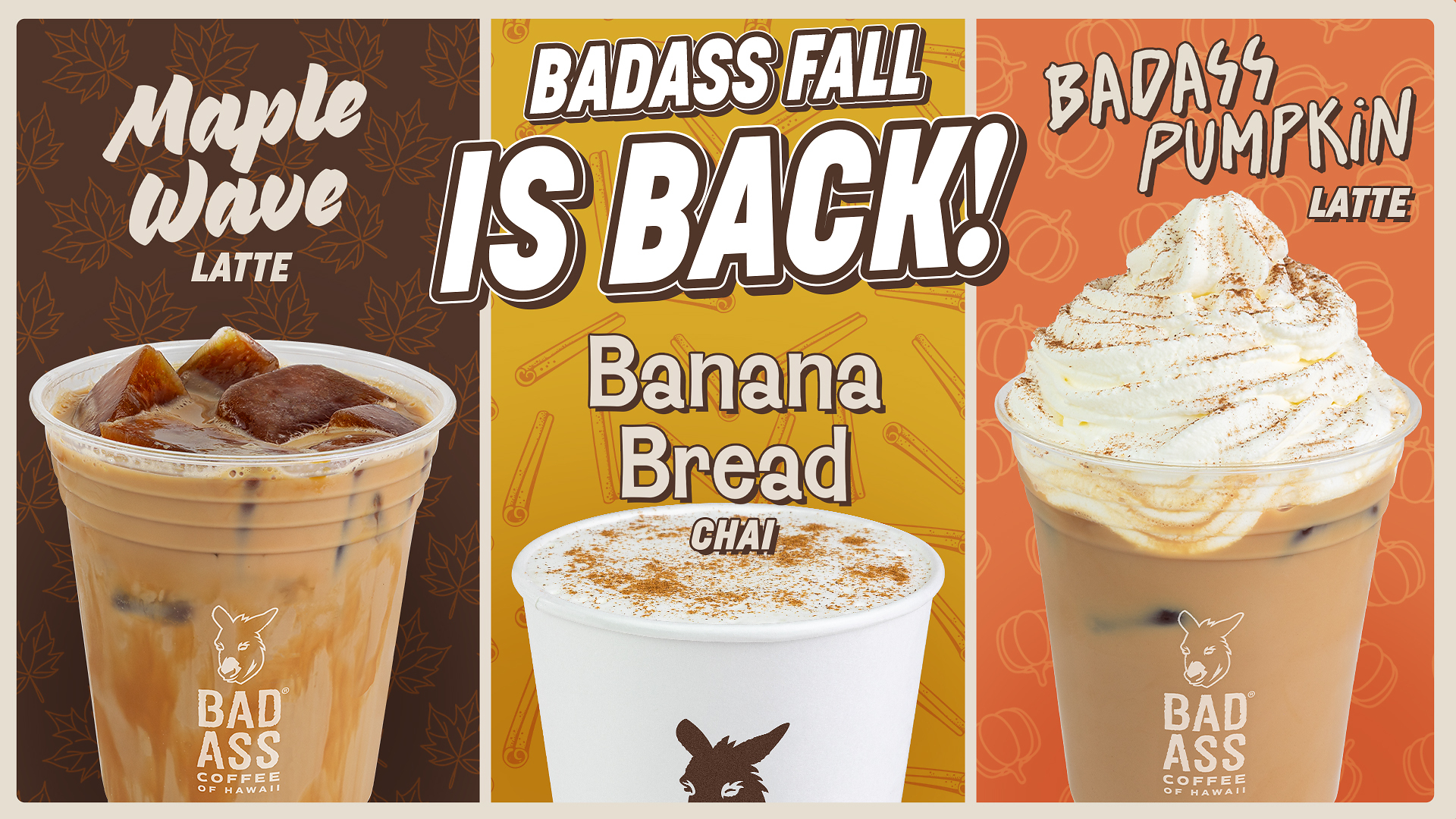
Bad Ass Coffee of Hawaii is running its fall limited-time menu from Aug. 25 through Nov. 30 at participating U.S. locations, bringing back three proven performers — the Maple Wave Latte ($6.05), Banana Bread Chai ($4.25), and Badass Pumpkin Latte ($7.80) — alongside Pumpkin Swirl Bread at $3.99. The return isn't a reactive decision; it's a deliberate repeatability play, leaning on documented guest demand to reduce menu development risk and compress time-to-launch.
What makes this campaign operationally interesting is the sequenced drop structure. Rather than front-loading the entire fall lineup, the brand is holding a surprise frozen drink reveal for Oct. 20 — a second traffic moment engineered mid-season to re-engage guests who already converted in late August. It's a tactic borrowed from streetwear and entertainment, now well-suited to the café franchise model where repeat visit frequency determines unit economics.
What the Menu Signals
For operators benchmarking LTO strategy, the price architecture here is worth noting. At $4.25 for the Banana Bread Chai and $7.80 for the Badass Pumpkin Latte, the range covers both the value-entry and the premium-impulse buyer — a deliberate spread that protects ticket average regardless of economic conditions. The inclusion of a food attachment (Pumpkin Swirl Bread) further supports basket-building without adding significant complexity to a franchise kitchen.
Iain Douglas, Chief Brand and Strategy Officer at Bad Ass Coffee of Hawaii, framed the return as a dual-audience move: "These menu items bring the cozy, familiar flavors people crave in fall, made with the same real Hawaiian coffee that sets us apart." The underlying intelligence is that returning LTO items carry lower customer education costs — operators spend less on awareness and more on conversion, which matters when marketing budgets at the unit level are tight.
With nearly 40 U.S. franchise locations open and 63 more in various stages of development, the brand is in active growth mode. That pipeline pressure makes a consistent, repeatable seasonal framework more valuable than a novel one — franchisees can plan staffing, inventory, and local marketing activations around a known calendar rather than absorbing last-minute creative pivots. Operators evaluating beverage franchise concepts should pay attention to how fall LTO architecture is increasingly used as a franchisee retention and recruitment tool, signaling operational maturity to prospective partners.
Takeaway for Operators
The broader read for independent café and QSR operators is that the "surprise drop" mechanic — withholding one SKU for a mid-season reveal — is now table stakes in competitive beverage marketing. It extends the media cycle, creates a second earned-content opportunity on social, and gives loyalty app users a reason to stay engaged between the August launch and the November close. Operators without a franchise infrastructure can replicate this at the unit level with minimal budget if the timing and channel sequencing are planned in advance.
For anyone tracking seasonal menu strategy and foodservice LTO trends, the Bad Ass Coffee calendar — summer frozen platform into fall warm-beverage anchor into mid-season frozen surprise — represents a coherent, channel-agnostic framework that translates across segments.
Written by Michael Politz, Author of Guide to Restaurant Success: The Proven Process for Starting Any Restaurant Business From Scratch to Success (ISBN: 978-1-119-66896-1), Founder of Food & Beverage Magazine, the leading online magazine and resource in the industry. Designer of the Bluetooth logo and recognized in Entrepreneur Magazine's "Top 40 Under 40" for founding American Wholesale Floral, Politz is also the Co-founder of the Proof Awards and the CPG Awards and a partner in numerous consumer brands across the food and beverage sector.