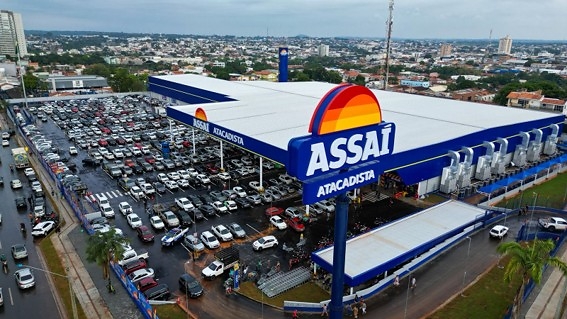
Brazil's wholesale food giant Assaí posted adjusted recurring net income of R$ 248 million in Q3 2026 — a 55.2% year-over-year jump — while simultaneously cutting its net leverage ratio from 3.03x to 2.15x. For operators, procurement teams, and suppliers tracking the Latin American foodservice supply chain, those two numbers together are the story: profitable growth and balance-sheet discipline executed in the same quarter, in a consumer environment marked by household debt pressure.
Gross revenue reached R$ 21.3 billion, up 2.7%, with gross margin expanding to 17.2% — a 0.45 percentage-point improvement. Critically, operating expense growth of 4.2% came in below Brazil's IPCA inflation rate of 4.4%, a sign that management is protecting unit economics rather than chasing top-line volume at the expense of margin. Adjusted EBITDA held at R$ 1.1 billion with a 5.7% margin. Customer traffic rose 2.1%, pushing monthly footfall past 40 million — a figure that underscores Assaí's role as a primary provisioning channel for small foodservice operators, restaurateurs, and institutional buyers across Brazil.
Ecosystem Diversification
The quarter's most strategically significant development is not the headline profit figure — it is the pace of ecosystem buildout. Assaí Farma, the company's pharmacy format, closed the period with 11 São Paulo units, all opened between July and November, with a target of 25 locations by December. That rollout is paired with a pharmaceutical e-commerce launch inside the 'Meu Assaí' loyalty app, complete with in-store pickup. For food-and-beverage operators who already rely on cash-and-carry formats for perishable and dry-goods procurement, the addition of pharmacy — and its associated foot-traffic draw — changes the destination dynamic of the store visit.
Private label is accelerating at a comparable pace. Assaí launched more than 30 new items in Q3, bringing its total to 140 SKUs across four brand tiers: Assaí, Assaí Chef, Econobom, and the newly introduced Assaí Bloom. The company is targeting 250 SKUs by year-end. For suppliers and co-manufacturers serving the Brazilian wholesale channel, that trajectory signals increasing shelf competition from house brands — a pattern that mirrors what global cash-and-carry operators like Costco and Metro AG have pursued for the past decade. Last-mile delivery grew 204% across 104 stores, and an acquisition of 18 gas stations in São Paulo lays groundwork for a convenience format expected to open in August 2027.
What This Signals for Operators
CEO Belmiro Gomes framed the quarter around controllables: pricing competitiveness, cash generation, and operational efficiency. That language maps directly onto the intelligence operators and buyers in the wholesale foodservice segment should be tracking. When a channel this large — serving more than 40 million customer visits per month — expands into pharmacy, app-based ordering, and convenience retail simultaneously, it restructures the competitive gravity for every supplier, broker, and distributor in its orbit.
For foodservice operators sourcing through cash-and-carry formats, Assaí's private label expansion in particular warrants close attention. As the SKU count scales toward 250 by December, branded suppliers will face intensified shelf pressure in categories where margin contribution is already thin. Meanwhile, the last-mile growth rate of 204% suggests Assaí is building a fulfillment capability that could eventually serve smaller foodservice accounts who currently rely on traditional distributors.
Operators and vendors tracking brand launch and retail readiness in Latin American channels should factor Assaí's private label trajectory into their planning cycles. And procurement teams evaluating wholesale and foodservice distribution channels should note that this operator's leverage reduction gives it the financial flexibility to accelerate format expansion well into 2027.
Written by Michael Politz, Author of Guide to Restaurant Success: The Proven Process for Starting Any Restaurant Business From Scratch to Success (ISBN: 978-1-119-66896-1), Founder of Food & Beverage Magazine, the leading online magazine and resource in the industry. Designer of the Bluetooth logo and recognized in Entrepreneur Magazine's "Top 40 Under 40" for founding American Wholesale Floral, Politz is also the Co-founder of the Proof Awards and the CPG Awards and a partner in numerous consumer brands across the food and beverage sector.