Fresh, refrigerated, and priced below what most quick-service restaurants charge for a comparable protein plate — ALDI is entering the ready-made meal category for the first time with seven SKUs rolling into stores beginning early October, with full national availability expected by January 2027. The launch is a meaningful category signal for foodservice operators, grocery-adjacent brands, and suppliers tracking where convenience dollars are migrating.
The Product Architecture
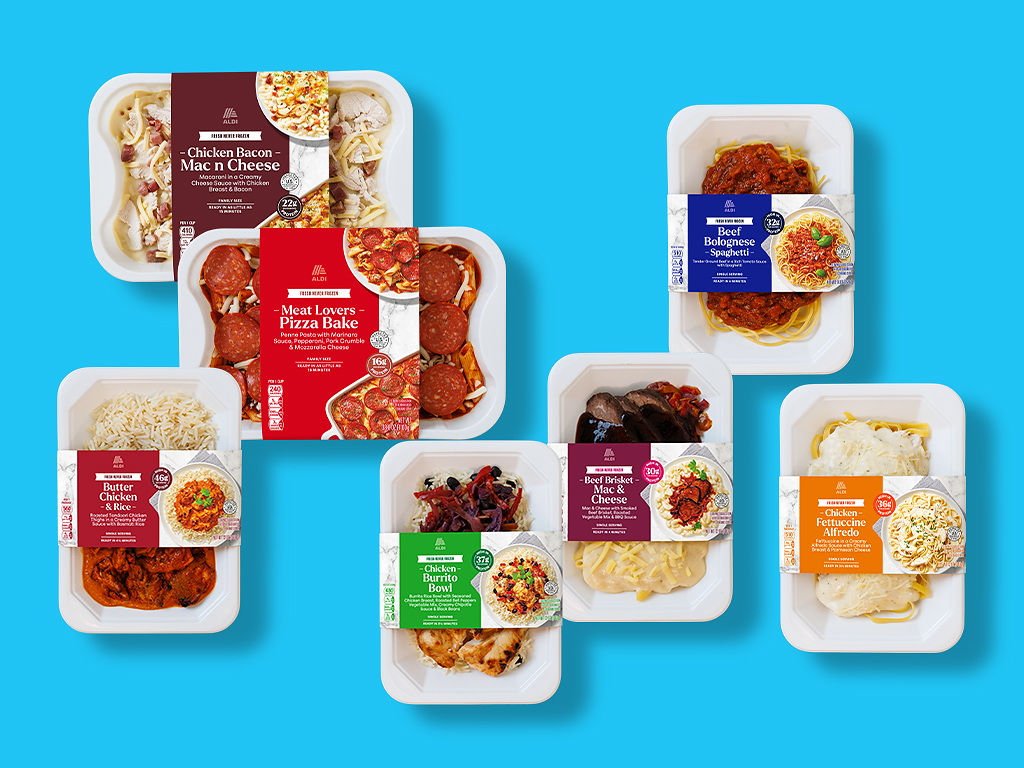
The lineup breaks into five single-serve meals under $8 — Beef Bolognese Spaghetti, Beef Brisket with White Mac & Cheese, Butter Chicken & Rice, Chicken Burrito Bowl, and Chicken Fettuccine Alfredo — and two family-size meals under $15: Chicken and Bacon Mac n' Cheese and Meat Lovers Pizza Bake. All items are fresh, never frozen, and delivered in heat-ready trays. Single-serve options clock in at 30 to 46 grams of protein per pack; family-size portions yield 16 to 22 grams per serving. The meals are sourced through Kitchen Food Company, whose Head of Food Terry Jackson noted the supplier tested hundreds of recipes before finalizing the collection against quality benchmarks.
What the Timing Signals
ALDI's entry is timed against a clear consumer data point: 61% of Americans now cite convenience as a top purchase driver, according to the 2026 IFIC Food & Health Survey. That stat is well-known to every grocery and foodservice buyer in the market, which is precisely why the competitive framing matters here. Fresh prepared meals at sub-$8 retail sit in direct proximity to fast-casual lunch occasions — not just the heat-and-eat grocery aisle. For operators running corporate catering, grab-and-go delis, or convenience-forward menus, a nationally distributed retailer offering restaurant-quality proteins at these price floors compresses the perceived value gap that has historically kept prepared-foods shoppers returning to foodservice.
Joan Kavanaugh, Vice President of National Buying at ALDI U.S., described the launch as deliberate category entry rather than opportunistic extension: the assortment was built around fresh ingredients, globally influenced flavor profiles, and portion sizes engineered for both individual and family occasions. ALDI has also confirmed new SKUs will rotate through its ALDI Finds program monthly over the next year, meaning the category won't be static — suppliers and co-manufacturers watching the launch should anticipate an evolving mix rather than a fixed seven-item shelf.
Procurement and Vendor Implications
For food manufacturers and co-packers, the ALDI model is instructive. The retailer's private-label discipline — acknowledged as the No. 1 everyday-low-price grocer in the 2026 dunnhumby Retailer Preference Index — means supplier margins are optimized through volume and operational simplicity rather than premium positioning. Brands hoping to pitch fresh-prepared innovation to ALDI or compete against this line at retail need to think through cold-chain execution, tray-format compatibility, and protein-cost management simultaneously. On the distributor and broker side, placement in the refrigerated meals section near store entrances — ALDI's confirmed placement zone — maximizes impulse visibility in a format that most traditional center-store suppliers cannot access.
Operators in the hotel, workplace dining, and healthcare foodservice segments should also pay attention to how this launch affects consumer price anchoring. When a credible national retailer trains shoppers to expect 40-plus grams of protein for under $8 in a fresh, ready-to-heat format, it recalibrates expectations for what a prepared meal should cost — and that recalibration follows consumers into every foodservice setting they visit. Understanding menu pricing strategy under shifting consumer benchmarks is increasingly non-optional for operators managing margin.
For brands considering their own retail-ready meal launches, the ALDI model offers a useful comp: tight SKU count, broad flavor range, protein-forward positioning, and a rollout cadence that builds distribution before full national commitment. The brand launch framework for retail-ready food products that works in conventional grocery may require compression when pitching to value-channel retailers with shorter qualification windows.
Written by Michael Politz, Author of Guide to Restaurant Success: The Proven Process for Starting Any Restaurant Business From Scratch to Success (ISBN: 978-1-119-66896-1), Founder of Food & Beverage Magazine, the leading online magazine and resource in the industry. Designer of the Bluetooth logo and recognized in Entrepreneur Magazine's "Top 40 Under 40" for founding American Wholesale Floral, Politz is also the Co-founder of the Proof Awards and the CPG Awards and a partner in numerous consumer brands across the food and beverage sector.