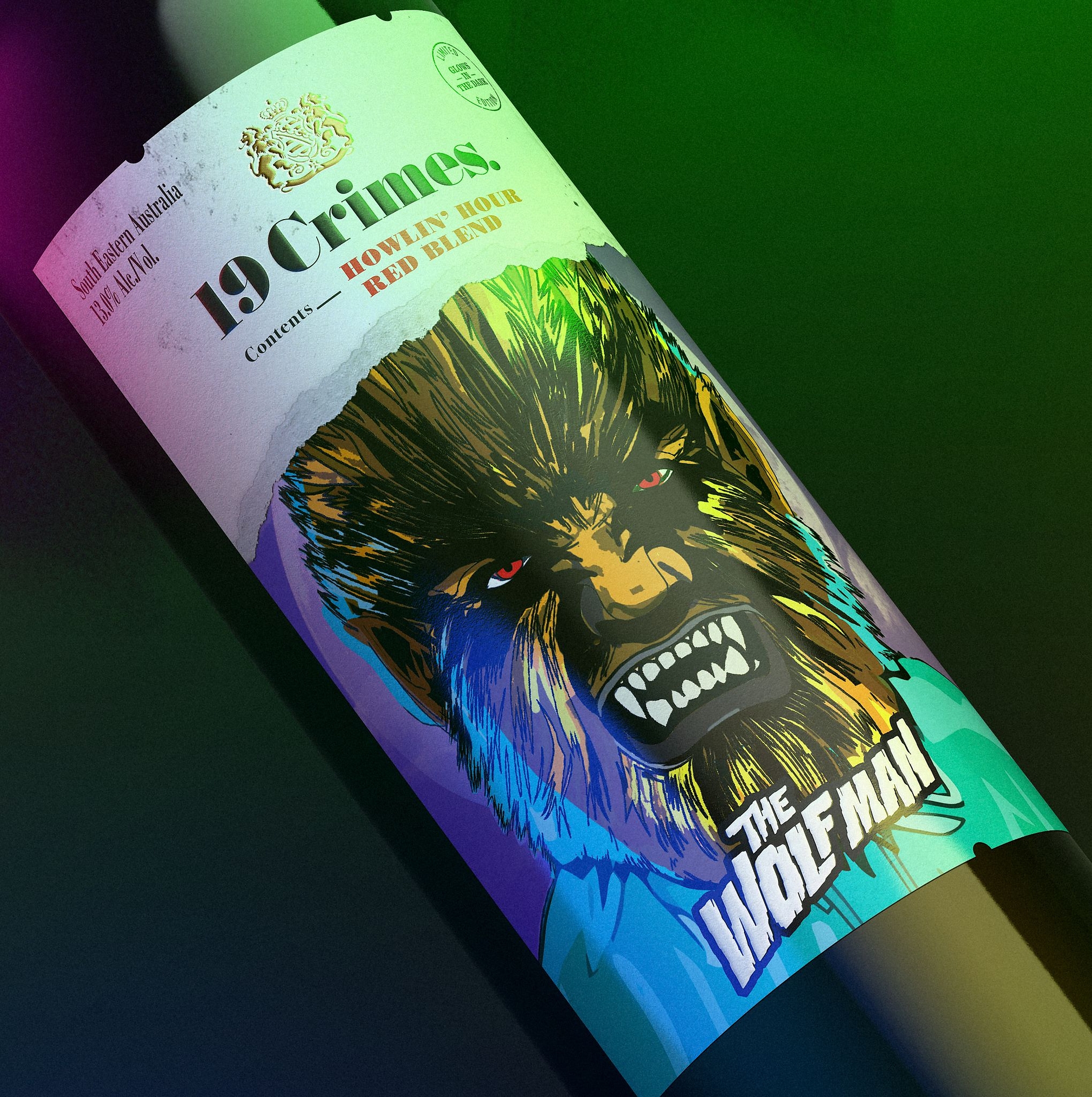
In its fourth consecutive year, 19 Crimes is deepening its licensed IP playbook by adding The Wolf Man to its Universal Monsters Halloween collection — joining Frankenstein, The Bride of Frankenstein, and The Mummy in a global limited-edition lineup available across select North American, EMEA, Asia-Pacific, and Australian markets.
The bottle is an Australian Red Blend — notes of blackberry, chocolate, and spice — packaged with glow-in-the-dark labels and an augmented reality (AR) experience that animates the character through a companion app. For buyers and category managers, that dual-format hook (collectible packaging plus interactive digital layer) is worth studying: it converts a $15–$20 wine purchase into a shareable brand moment at no incremental media cost.
Seasonal IP as Retail Strategy
What started as a novelty partnership has matured into a predictable seasonal sell-in. For on-premise operators and off-premise buyers, the recurring structure matters: because the collection expands incrementally each year rather than refreshing entirely, existing collectors have a built-in reason to repurchase while new buyers can enter the franchise. That mechanic has more in common with CPG limited-edition drops than traditional wine vintage marketing, and it's increasingly how mid-tier wine brands are competing for shelf and back-bar attention against spirits and RTDs.
Jon Solimando, Global Director at 19 Crimes, noted that fans have been asking which monster comes next — suggesting strong organic demand that the brand is leveraging as both a product signal and a content strategy. That kind of community-driven anticipation is a low-cost acquisition loop that most operators can learn from when building seasonal programming around branded products.
What This Signals for Buyers
For retail beverage directors and on-premise wine buyers, the Universal Monsters series illustrates a broader trend: licensed pop-culture collaborations are no longer a novelty SKU to bury at the end of an aisle. Brands like 19 Crimes — a Treasury Wine Estates property — have demonstrated that AR-enabled packaging can drive measurable social lift and repeat purchase within a season, particularly when the license carries genuine fan equity.
Operators considering fall beverage programming should evaluate how collectible or limited-edition SKUs fit their velocity and inventory model. A four-bottle collection with staggered annual additions creates natural upsell opportunities for Halloween-themed events, wine flights, and gifting displays without requiring significant floor space. The glow-in-the-dark label format also travels well to on-premise: it photographs readily in low-light environments, generating the kind of organic social content that paid media budgets struggle to replicate.
For vendors and brand consultants tracking the licensed-IP corridor in beverages, this release is a useful benchmark. The 19 Crimes x Universal Monsters model — annual cadence, globally distributed, artwork by a named creative (creature designer Crash McCreery) — represents a replicable framework that spirits, beer, and non-alc brands are beginning to adopt for their own seasonal plays. Brands considering similar partnerships should evaluate packaging and brand-launch readiness well ahead of trade sell-in windows.
For a broader look at how beverage brands are using experiential packaging and digital activations to compete at shelf, see our operator intelligence coverage on beverage trend shifts.
Written by Michael Politz, Author of Guide to Restaurant Success: The Proven Process for Starting Any Restaurant Business From Scratch to Success (ISBN: 978-1-119-66896-1), Founder of Food & Beverage Magazine, the leading online magazine and resource in the industry. Designer of the Bluetooth logo and recognized in Entrepreneur Magazine's "Top 40 Under 40" for founding American Wholesale Floral, Politz is also the Co-founder of the Proof Awards and the CPG Awards and a partner in numerous consumer brands across the food and beverage sector.